
The Art Life
Creativity takes time. Some ideas require an uncomfortably long and uninterrupted period of time. One of David Lynch’s early mentors, Bushnell Keener, said to him: “If you want to get one hour of good painting in, you have to have four hours of uninterrupted time.”
When we think of our favourite artists, we might imagine that they are just always bursting with inspiration, and once sat down in their creative space, they go at it, drafting, reorganizing, cutting, editing, doing, un-doing and re-doing. That’s sort of the glamorous Hollywood version of it. But we don’t typically imagine them in periods of creative block. It’s that moment when they seem like they are much more like ourselves, where there is nothing in arm’s reach and the artist much reach further. Lynch elaborates:
“It’s a matter of sitting back and studying it and studying it and studying it; and suddenly, you fin you’re leaping up out of your chair and going in and doing the next thing.” He ends the thought: “If you know you’ve got to be somewhere in half an hour, there’s no way you can achieve that. (Lynch, 2006, pg. 11)”
Down Time.
It’s becoming ever more difficult to find ourselves that space for long, deep uninterrupted time. Many of us who have jobs, classes, chores, or children might say to Bushnell Keener: “Who the hell has 4 hours of uninterrupted time, anyway?”
But even when we do have down-time, sometimes at the bus stop, walking the dog, having our first morning cup of coffee, or laying awake in bed; our phone is always beside us.
With unlimited access to the infinite spring of information, we are able to impulsively zap away every pang of boredom the moment it creeps up. We put in our earphones. We google a query. We check our notifications. We watch a movie. Sometimes we don’t even want to, it’s just an automatic muscle memory response. Our impulse to eliminate boredom prevents us from immersing ourselves in it.
Boredom.
A lot of us may think of boredom as something bad, and some philosophers and writers such as Kierkegaard or Baudelaire would agree. Even the earliest Christian teachers had something to say about idle hands. However, consider Walter Benjamin. He had a really romantic and refreshing way of seeing boredom.
In his essay The Storyteller, he touts: “If sleep is the apogee if physical relaxation, boredom is the apogee of mental relaxation. Boredom is the dream bird that hatches the egg of experience. (Benjamin, 1936, pg. 367)” When we allow ourselves to steep in boredom, once we overcome our restlessness and fidgeting, our brains begin to attune to a slower frequency and we find ourselves capable of deep contemplation and immersive reflection. We may begin to observe details in the banal. In Lynch’s case, an idea that’s been laying dormant suddenly leap out from the dark in front of him. Benjamin describes boredom as:
“…a warm gray fabric lined on the inside with the most lustrous and colourful of silks. In this fabric we wrap ourselves when we dream. We are at home then in the arabesques of its lining.” (D2a,1, Arcades Project, Benjamin.)
Immersive Attention.
In the article titled: Harvard art historian Jennifer Roberts teaches the value of immersive attention, Mrs. Roberts divulges her prescribed method for students preparing to write an extensive art analysis. Before allowing the student to do any research on the piece or the artist, she assigns them to “go to the Museum of Fine Arts, where it hangs, and spend three full hours looking at the painting, noting down [their] evolving observation as well as the questions and speculations that arise from those observations. (Roberts, 2013)” Now doesn’t that sound familiar? Roberts claims her initially reluctant students again and again return surprised by how much detail and depth they uncover from within the paintings in those three hours.
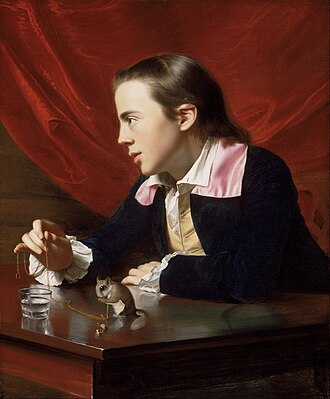
This process of deceleration is meant to slowly open up the senses. You get past the immediate first impressions, and and then to the point when you’re convinced you’ve observed every detail sufficiently. And you keep going far beyond that point. And then you see something new. And something else new. You discover peculiar details and make subtle but profound connections. Roberts describes her own process as she observes John Singleton Copley’s 1765 painting A Boy with a Flying Squirrel:
“It took me nine minutes to notice that the shape of the boy’s ear precisely echoes that of the ruff along the squirrel’s belly— and that Copley was making some kind of connection between the animal and the human body and the sensory capacities of each. It was 2 minutes before I registered the fact that the fingers holding the chain exactly span the diameter of the water glass beneath them. It took a good 45 minutes before I realized that the seemingly random folds and wrinkles in the background curtain are actually perfect copies of the shapes of the boy’s ear and eye…”
And so on. While “it is commonly assumed that vision is immediate,” Roberts explains, “[students discover in a visceral way] that in any work of art there are details and orders and relationships that take time to perceive.”
Conclusion
In a world of instant gratification and hyper-productivity, we are rarely forced into these moments of true down-time, where we allow ourselves to become truly bored and allow our minds to wander uninterrupted into deep territory. And it certainly doesn’t come easy at first. Patience and immersive attention is a skill to be honed, a muscle to be worked and developed. We have to overcome that restless fidgeting urge to distract ourselves from boredom, and instead and embrace the lush grey tapestries that Walter Benjamin speaks so dreamily of. It is there in which our most profound and creative ideas swim, waiting to be caught and reeled back up to the surface. David Lynch says,
“Desire for an idea is like bait. When you’re fishing, you have to have patience. You bait your hook, and then you wait. The desire is the bait that pulls those fish in—those ideas. (Lynch, 2006, pg. 25)”
Leave a Reply