In his first instalment of Patronizing the Arts, Ivar sees Seattle-based World Music ensemble Serica at Granville island. Will Serica survive his incessant patronizing? Read on to find out!
Walking a narrow upstairs corridor, I enter the Zameen Art House, located tucked away discreetly on Anderson Street on Granville Island. The space resembled a cool jazz lounge: dim lights against dark curtained walls, a Persian rug on wood-panelled flooring in lieu of a stage. Missing was the stale stench of cigarette trays. The art house is Persian-Run, as reflected by most of the patrons. Between the chatter of the audience, I could hear a violin warming up in the green room.
People settled into their seats as percussionist and bandleader Rambod Dargahi stepped into the spotlights introduced himself. He firstly expressed his humble gratitude at the audience attendance, which included the many members of his Iranian family who had been unable to attend any of his shows in the US. He acknowledges the fresh scars he and his community are carrying through the continuing Iran War, like a “dark night without stars or sunrise.” But he also expresses the importance of being present in the now, gathering together as a community, and celebrating the culture through the power of music. He then announces his band, Serica.
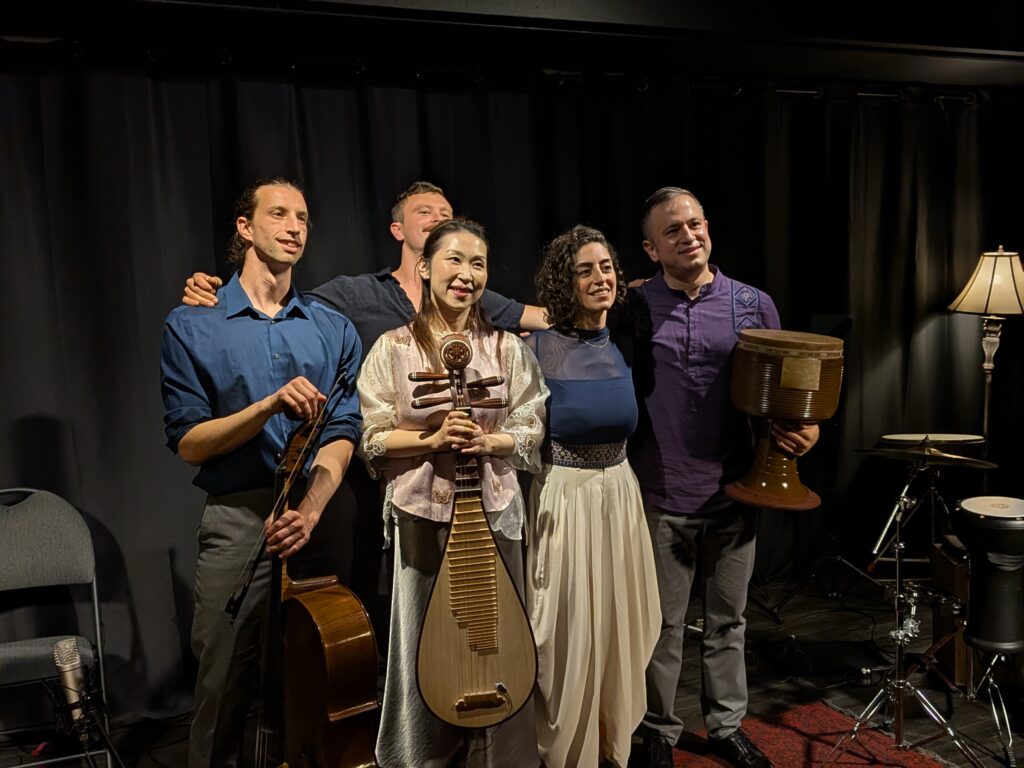
Their opening piece serves as their thesis statement, in which they arrange a medley beginning with a traditional Chinese folk song, transitioning seamlessly into a bluegrass shuffle, and ending on a rhythm heavy Persian piece. Dargahi’s percussion work and Adrian Golay’s Cello builds the rhythmic low-end, while Jazz guitarist Martin Budde, Violinist Shagha Taheri, and Pipa player Carrie Wang trade leads lines, melodies and counterpoints. The instrumentalists are masters of dynamics, knowing when to take the lead, when to sit back, when to drop-out and come back in, when to improvise and when to return to the motifs of the piece. Serica enters a crossroads that is both geographically and temporally suspended, bouncing back back and forth between of with contemporary standards and compositions. In their East-Meets-West-Meets-Middle-East style, they reimagine classics like Libertango, The Shadow of your Smile, and the Cherokee Shuffle.
Originally meeting in Massachusetts at a workshop run by Silkroad Ensemble World Music program, these musicians relocated and remanded as Serica in Seattle, Washington. Their namesake comes from a Silk Road terminus in the northern regions of China, and their music aptly reflects a crossroads of tradition and culture. The compositions frequently blend Chamber strings, jazz guitar, Chinese folk instruments, and Middle Eastern percussion,
The gorgeous playing and tasteful arrangements makes the Serica experience palatable and pleasing, and I was left wanting to see where they would go next. They made fantastic work of blending the past and present into their work, but I imagine where they could go if they decided to charter out towards the future as well. Too see the unique ensemble of instruments approach avant-garde methods, such as atonalism, or loop pedals, or process music, would set them apart from the regular World Music fare and put them in a category of their own.
My favourite piece was the closer, where the song ends in an energetic percussion solo by Dargahi. Wang stood up and began singing a traditional Iranian folk song, and the Persian majority crowd joined in with clapping and chanting. The energy in the room reach a fever pitch when Dargahi delivered the finale, and the band was met with cheers and ululation from the crowd.
Serica put on a fantastic, impassioned performance at Zameen Art House, syncretizing folk music, classic compositions and jazz standards into a seamless experience, and their passion for music and exploration is infectious. Their ability to bridge gaps between regions with their music proves that we have much more in common than we have differences.